Discover the key differences between pharmaceutical pellets, MUPS, and granules. Learn about their manufacturing processes, shapes, and drug-release profiles.
Written By
Aishwarya Salunkhe
Published on
19 August 2026
Tags
The pharmaceutical industry is increasingly adopting multiparticulate dosage forms as an alternative to conventional single-unit formulations. These systems contain multiple small units, such as pellets or granules, within a single dosage form and offer greater flexibility in drug-release design, improved formulation performance, and the ability to address the specific characteristics of an active pharmaceutical ingredient (API).
Among the various methods of multiparticulates, pharmaceutical pellets and granules are commonly used to produce oral solid dosage forms. The use of pellets is especially beneficial in cases where there is a requirement for controlled release of the drug using methods such as drug layering and functional coating.
The idea behind Multiple Unit Pellet Systems (MUPS) is to use not a single unit but several units of either coated or uncoated pellets, combined within a tablet. This makes MUPS a significant oral drug delivery system today.
However, these three systems are not necessarily interchangeable because they have different structural attributes, manufacturing processes, and drug-delivery capabilities. Selecting the correct system is crucial to achieve the intended drug-delivery profile, stability, and dose uniformity. By understanding the distinctions between systems, formulators can select the most appropriate system for their application.
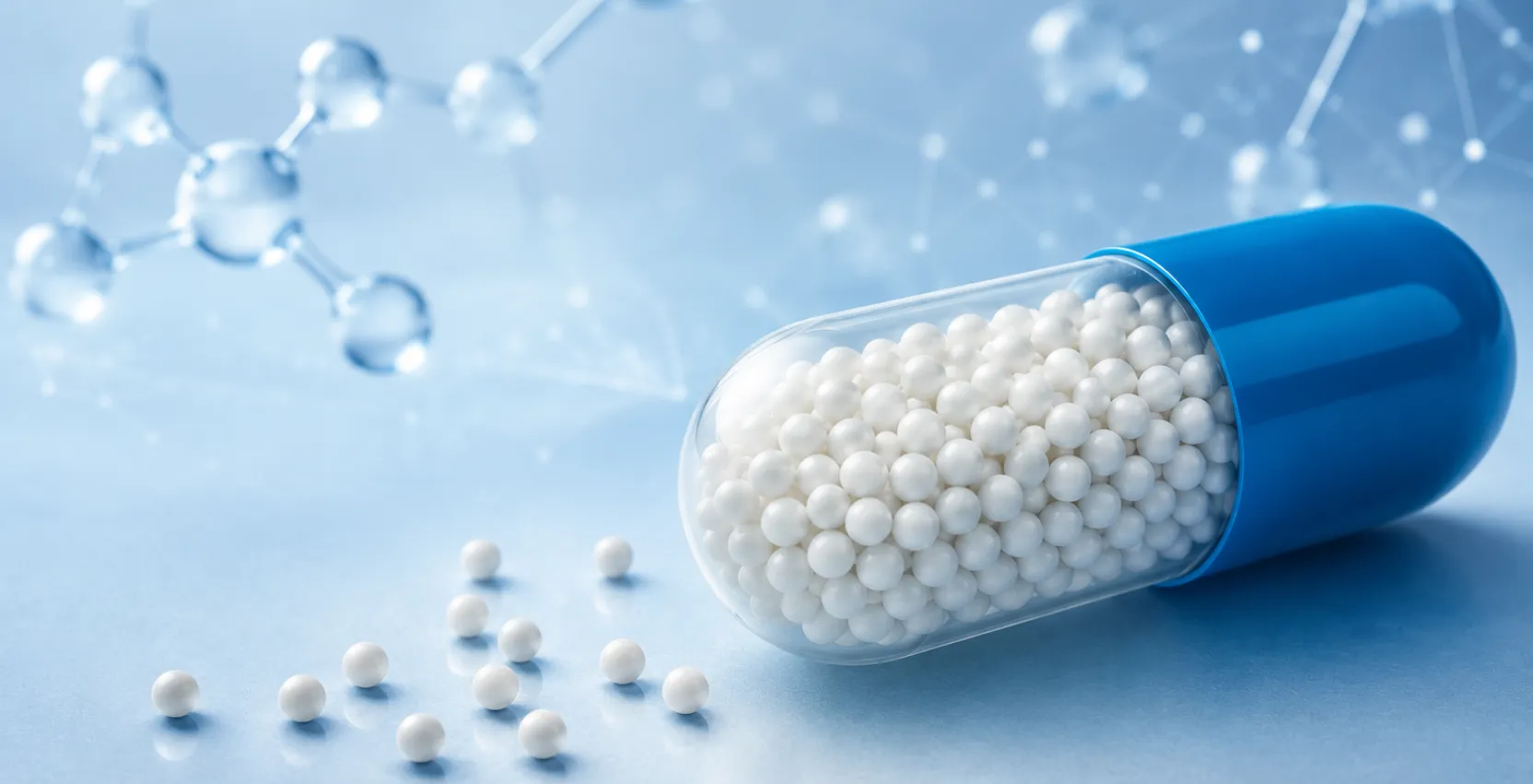
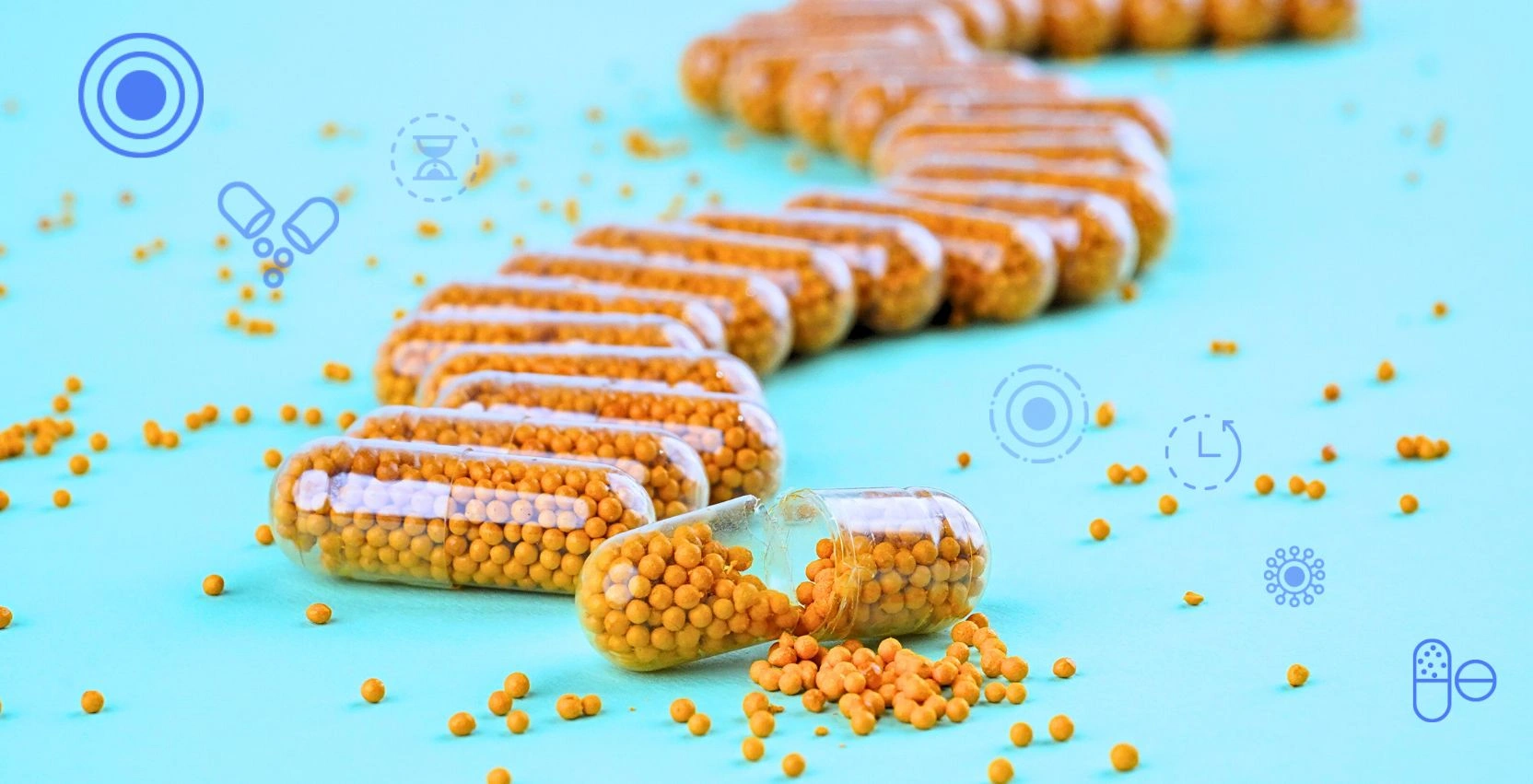
Pharmaceutical pellets are free-flowing, spherical/semi-spherical multiparticulates that contain both the active pharmaceutical ingredients (APIs) and appropriate excipients. They may be found in oral solid formulations and packed in capsule or tablet form, or as a Multiple Unit Pellet System (MUPS).
Due to their small size and uniformity, pellets provide a large surface area for coating. This gives the manufacturer an option for how the drug will be released. Pellets may be formulated in different ways, depending on the requirements.
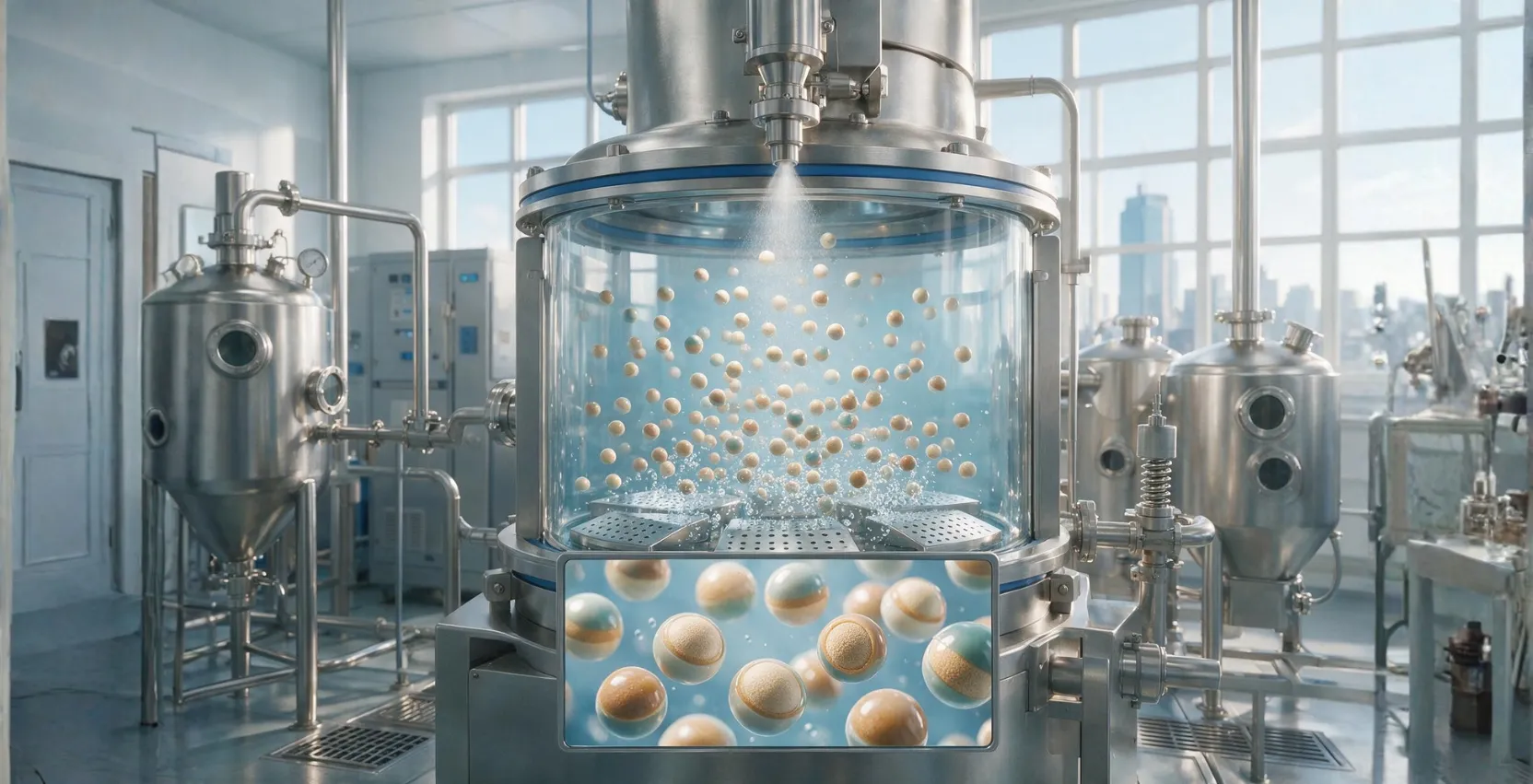
Pellet formation usually involves transforming powders or granules into compact, spherical entities through pelletization. One common approach is extrusion-spheronization, in which a powder mixture is blended with a binder and formed into spheres through extrusion and spheronization.
Drug layering is another useful technique, in which the API is layered onto starter cores or pre-existing pellet cores using an appropriate binder solution or suspension. Additional coating can be applied to the pellets to achieve the required protection or drug-release profile.
Pellet size may depend on factors such as the drug formula, the manufacturing processes used, and the intended use. Pellets in some drug formulations are in the sub-millimeter to millimeter range, typically 0.5–1.5 mm.
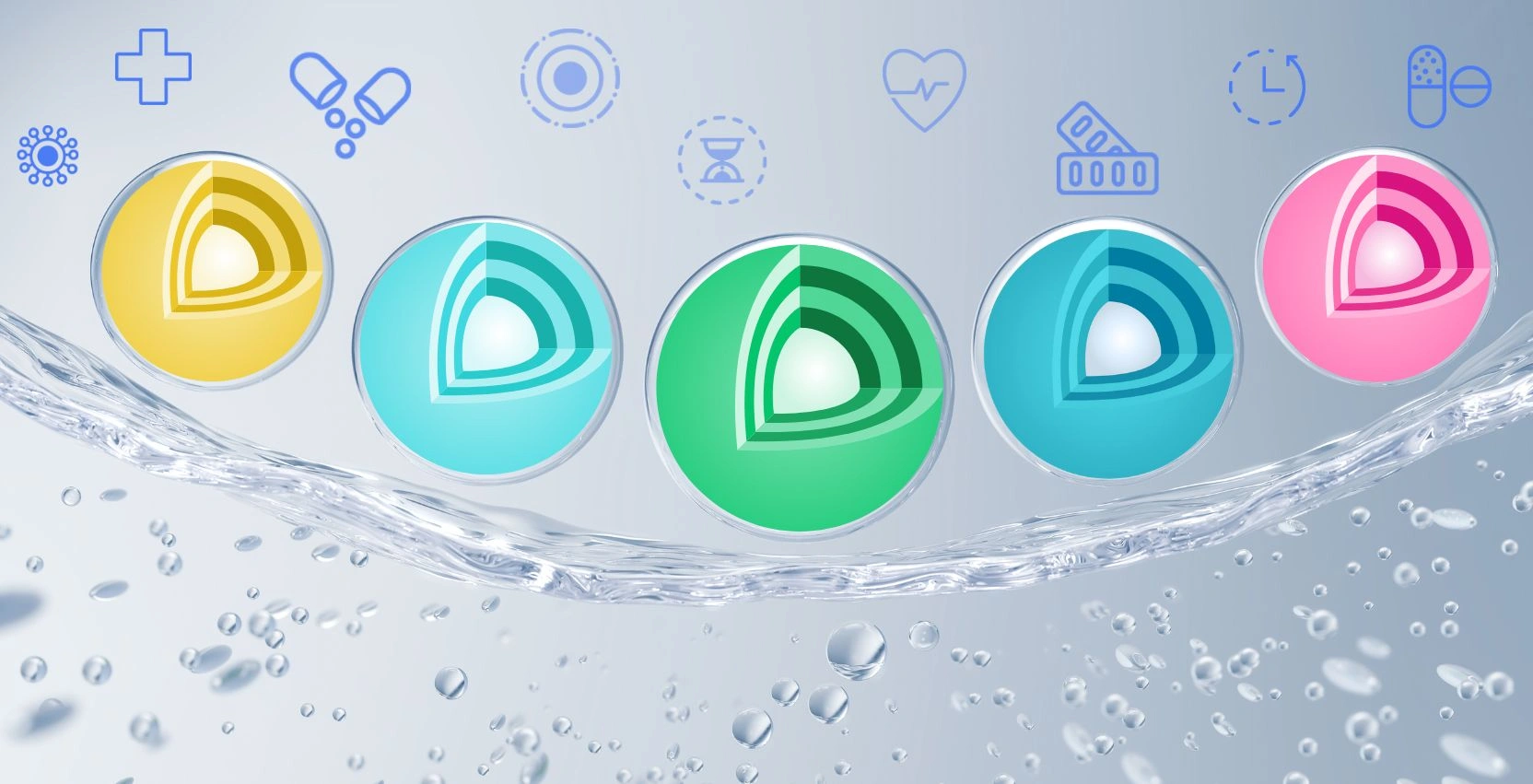
Pellet technology provides flexibility in pharmaceutical formulations. Coating each pellet separately allows you to create pellets with different release properties from the same dosage form. This gives great applicability of the pellets to:
Immediate release pellets for fast drug availability
Sustained release pellets for long drug release
Delayed release pellets for release after a certain time period
Enteric coated pellets for protection from acidic stomach and controlled release in the intestines
These pellet modifications provide a flexible technology for pellet manufacture.
Drug granules are larger clusters of particles formed by combining smaller powder particles into more compact forms. Granulation is a common process in drug manufacturing that improves the flow, compressibility, handling, and homogeneity of powders before converting them into dosage forms.
Compared with powdered forms, granular forms have larger particle sizes and better flow characteristics, making processing easier during tablet formation or capsule filling.
Two main processes are used for pharmaceutical granulation.
Wet granulation involves adding a granulating solvent or binder solution to a mixture of powder materials. The resulting wet mass is then dried to the desired moisture content and particle size.
In dry granulation, no solvent is used as a binder. The powders are compacted under pressure to form larger particles, which are then sized into granules.
Granulation has different uses depending on the formulation of the granulated material. Granules can be made into tablets, filled into capsules, or even dispensed in sachets and powders for oral use. Better flow and compressibility in granules can improve the manufacturing process.
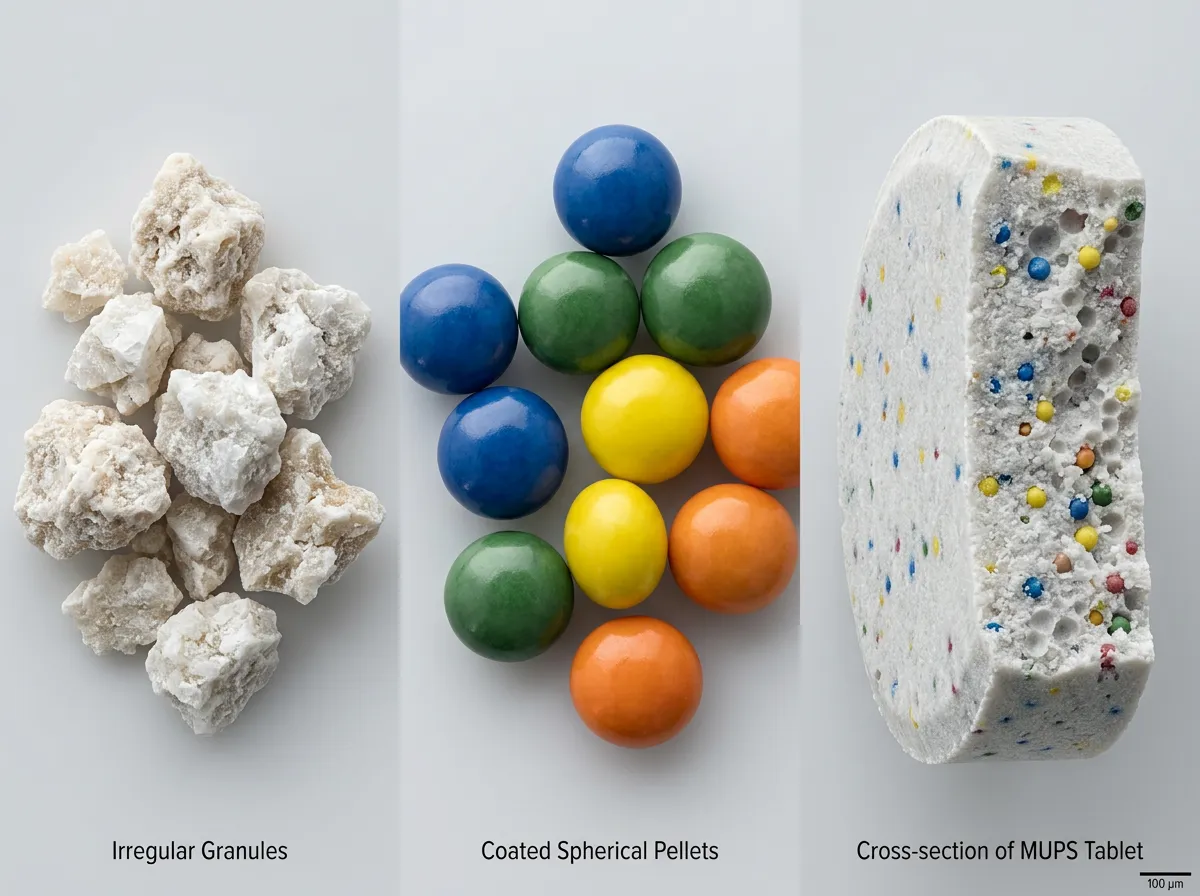
While both are multi-particle systems, granules and pellets differ in shape, manufacturing method, and application. Granules are irregularly shaped particles, while pellets are small, spherical or semi-spherical entities produced by pelletizing processes such as extrusion-spheronization or drug coating.
Pellets are well-suited for controlled coating and drug release because their regular spherical shape provides a surface suitable for functional coating. Granules are advantageous when improved flow and compression properties are desired.
A MUPS is the abbreviation for Multiple Unit Pellet Systems, which are solid oral dosage forms that involve the use of many pellets within a single tablet. Unlike a normal tablet, a MUPS tablet will not have only one drug-containing unit. Instead, there will be many pellet units with different characteristics of drug release.
Manufacturers usually make MUPS tablets by adding coated or uncoated drug pellets to the right tablet formula, then compressing it into a single tablet. The coatings on the pellets are meant to withstand compression while maintaining the desired drug-release characteristics. The result is a tablet that is easy to take, like a regular tablet, but contains several pellets.
MUPS tablets belong to multiparticulate drug delivery systems because the drug dose is distributed in many individual particles rather than in a single drug-containing particle. When the tablet breaks down, the individual particles separate and can act as individual entities in the gastrointestinal tract.
Such a multiparticulate system may provide more uniform distribution of the drug within the gastrointestinal tract than the single-entity drug dosage forms.
One of the principal benefits of using MUPS in pharmacological applications is that each pellet can be designed separately before being compressed into a tablet. For instance, pellets can be designed as fast-, prolonged-, delayed-, or enteric-release pellets using the respective coating.
After proper formulation and compression, the pellets retain their individual properties even after being formed into a MUPS tablet. After the MUPS tablet disintegrates in the gastrointestinal tract, the individual pellets begin to exhibit their specific drug-release profile.
Thus, MUPS tablets provide both the convenience of tablet administration and the formulation diversity of pharmaceutical pellets.
Pellets, granules, and MUPS are all unique drug delivery systems, each with its own strengths depending on the formulation and drug release. Granules primarily improve powder flowability, handling, and compressibility. Pharmaceutical pellets are more flexible for drug layering and functional coating. MUPS (multiple unit pellet systems) are drug delivery systems that combine the features of both tablets and pellets.
Selection among these technologies depends on many criteria, such as the nature of the API, desired delivery profile, stability, manufacturing process, and the dosage form itself. These comparisons help formulators select the technology that yields the best results in oral solid formulations.
With our pellet production and coating capabilities, Umang Pharmaceuticals formulates various types of pharmaceutical pellets, including immediate-release, sustained-release, delayed-release, and enteric-release. This enables pharmaceutical companies to obtain custom-made pharmaceutical pellets tailored to their specific needs.
Aishwarya Salunkhe
14 July 2026
Learn how Pancreatin EC Pellets overcome acid sensitivity, enhance enzyme stability, improve intestinal targeting, and support scalable pharmaceutical manufacturing.
Read More →
Aishwarya Salunkhe
19 August 2026
Discover the key differences between pharmaceutical pellets, MUPS, and granules. Learn about their manufacturing processes, shapes, and drug-release profiles.
Read More →
Aishwarya Salunkhe
14 July 2026
Explore five common challenges in pharmaceutical pellet manufacturing, from pellet size and drug loading to coating, API protection, and scale-up.
Read More →
Aishwarya Salunkhe
02 February 2026
Understanding the advantages of floating drug delivery systems (FDDS) in nutraceuticals. Learn how these systems optimize absorption, release, and efficacy
Read More →
Aishwarya Salunkhe
02 February 2026
Explore how enteric-coated pellets protect active ingredients from gastric acid, resulting in optimum release and bioavailability in pharmaceutical formulations
Read More →
Aishwarya Salunkhe
15 June 2026
Understand how multiparticulate technologies transform medication delivery by improving absorption, controlling release, and providing patient-friendly alternatives for current medicines
Read More →

INDIA - CORPORATE OFFICE
Unit No. 1, 2nd Floor, Vicino (Mega Mall), New Link Rd, Oshiwara, Andheri West, Mumbai, Maharashtra, India. 400102
MANUFACTURING FACILITY
Unit No. 1, Survey No. 52/2, NH8, Shirsad, Vajreshwari Road, Opp. Mandvi Police Station, Village - Mandvi, Taluka- Vasai, District- Palghar 401 303, India.